On Wednesday night, after announcing the firing of Joe Paterno, about 2,000 students turned out to protest. While there was some peaceful protesting, there were a small group of protestors who created quite a bit of damage. Below are some of the images from the protest:
A media van was overturned by angry protestors:

Crowds gathering Wednesday night:


Some anti-Paterno demonstrators:
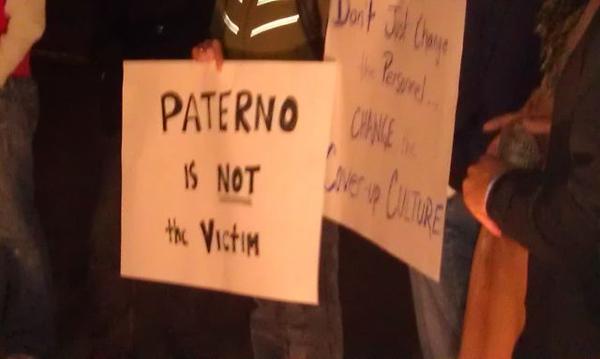
For me, the firing of Mr. Paterno was a “no-brainer.” Students attending Penn State, I would assume, are compassionate, and educated enough to know that what he did was wrong. So, how did they get to this point? Per the provost, the students had undergone a lot during the week leading up to the protests. In less than a week, the campus went from being completely normal, to chaotic. Starting the Friday before Paterno’s firing, Jerry Sandusky was arrested (he was the one charged with sexual assaulting up to 8 young boys), Tim Curly and Gary Schulz were fired Monday (for not reporting the abuse), Paterno announced his retirement at the end of the semester on Wednesday morning, and then on Wednesday night Paterno was fired. Students began to feel that everything was falling apart right before their eyes. On top of that, the media was hovering and the students started acting out and getting attention.
So, what professionals are better suited to look into how students are feeling than student affairs? That is exactly what the article in Inside Higher Education addressed. Student affairs will be there to help students process and create a bridge between students and administrators. NASPA and other leaders in Student Affairs are encouraging Penn State to use this as a teachable moment.
Did these students react to Mr. Paterno’s arrest because he was the head coach who had brought many wins to the college? Would they have reacted this way to any other person being fired for the same thing? Perhaps, this is a moment to look at ways in which institutions allow coaches at big athletic colleges to become such an monumental figure at an institution. Their salaries are just one demonstration of the elevated position coaches are put in. I did not hear of students protesting the firing of the Penn State president.
Overall, this is a teachable moment for both students and colleges. At my institution, we have already received an email reminder that employees are obligated to report any inappropriate behavior and to use Penn State as an example of what we should not allow to happen. Students should learn from Mr. Paterno’s mistake and know when it is appropriate to report something to a supervisor and when it is appropriate to go straight to the authorities. This should also be a learning lesson for college and university staff. I still do not understand why students felt the need to protest the firing of a man who covered up sexual assault of young boys. Perhaps the students were just facing the perfect storm of media chaos, several changes in a short period, and a feeling of loss within a strong community.
